What is it, in plain words?
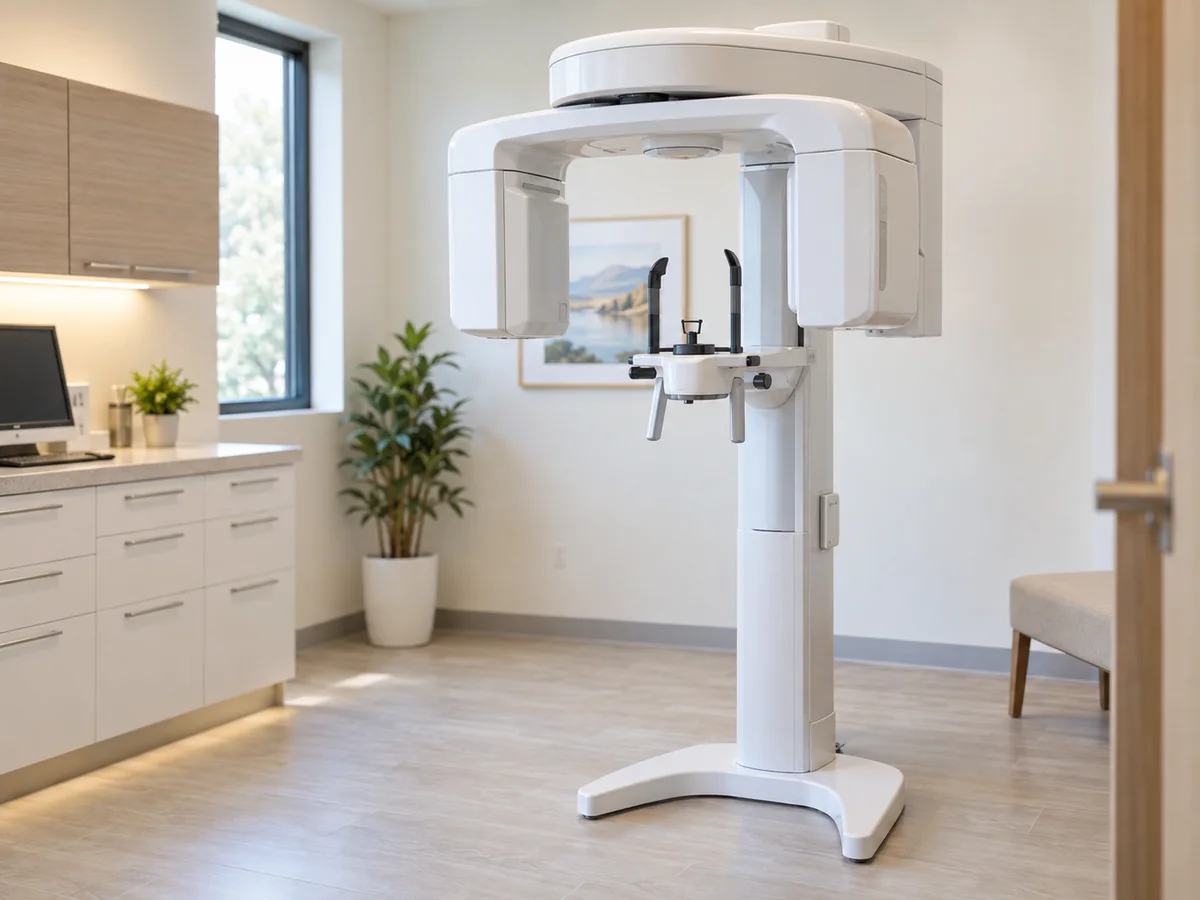
A regular dental X-ray is like a close-up photo of a few teeth. A panoramic X-ray is more like a wide-angle photo of your whole mouth: your upper and lower teeth, their roots, your jaw bones, your jaw joints, and the sinuses just above your upper teeth, all in a single image.
“Digital” means the picture is captured by an electronic sensor instead of on film. It appears on our screen within moments, with no waiting and no developing chemicals.
What happens during a scan
- We get you ready. We’ll ask you to take off earrings, glasses, and anything metal near your head, since metal shows up on the image.
- You stand still and bite gently on a small guide. This keeps your head in the right position. Nothing large goes in your mouth.
- The arm moves slowly around your head. It doesn’t touch you. Just stay still for a few seconds while it makes its circle.
- We go over the image with you. We zoom in on anything worth a closer look and explain what we see.
Why it matters to you
It sees what eyes can’t
Wisdom teeth, the bone that holds your teeth in place, and changes in your jaw are all invisible from the outside. Finding problems early usually means simpler, smaller treatment.
More comfortable
There’s no bulky sensor to hold inside your mouth. That’s easier for children, for people with a strong gag reflex, and for anyone with a sore mouth.
A very low dose
Digital X-rays need less radiation than older film X-rays. A panoramic X-ray is a very small dose, roughly equal to a few days of the natural background radiation we all receive from everyday life.
Clearer conversations
A digital image can be enlarged and brightened on screen, so we can show you exactly what we’re seeing instead of just describing it.
When we might use it
- Your first visit, to get a complete baseline picture of your mouth.
- Checking on wisdom teeth and teeth that haven’t come in yet, in both teens and adults.
- Planning dental implants, where we need to see how much bone is available.
- Jaw pain or TMJ concerns, and before orthodontic treatment such as Invisalign.
Good to know
- A panoramic X-ray is great for the big picture, but it’s less detailed for small cavities between teeth. For those, we may still take small “bitewing” X-rays.
- We only take X-rays when they will help your care, and how often depends on your own needs, not a fixed schedule.
- If you are or might be pregnant, please let us know. We’ll talk through your options, and X-rays that aren’t urgent can often wait.
Want to see it for yourself?
Ask us about panoramic X-rays at your next visit. We’re always happy to explain how we use our technology and what it means for your care.